
Location Profile Redesign
Modernizing a legacy core workflow for multi-location businesses.
Improved clarity and usability for managing location data across Google and major listings.
Role
Senior UX Designer
Time Period
Q3–Q4 2025
Company
Uberall
Platform
Web Application
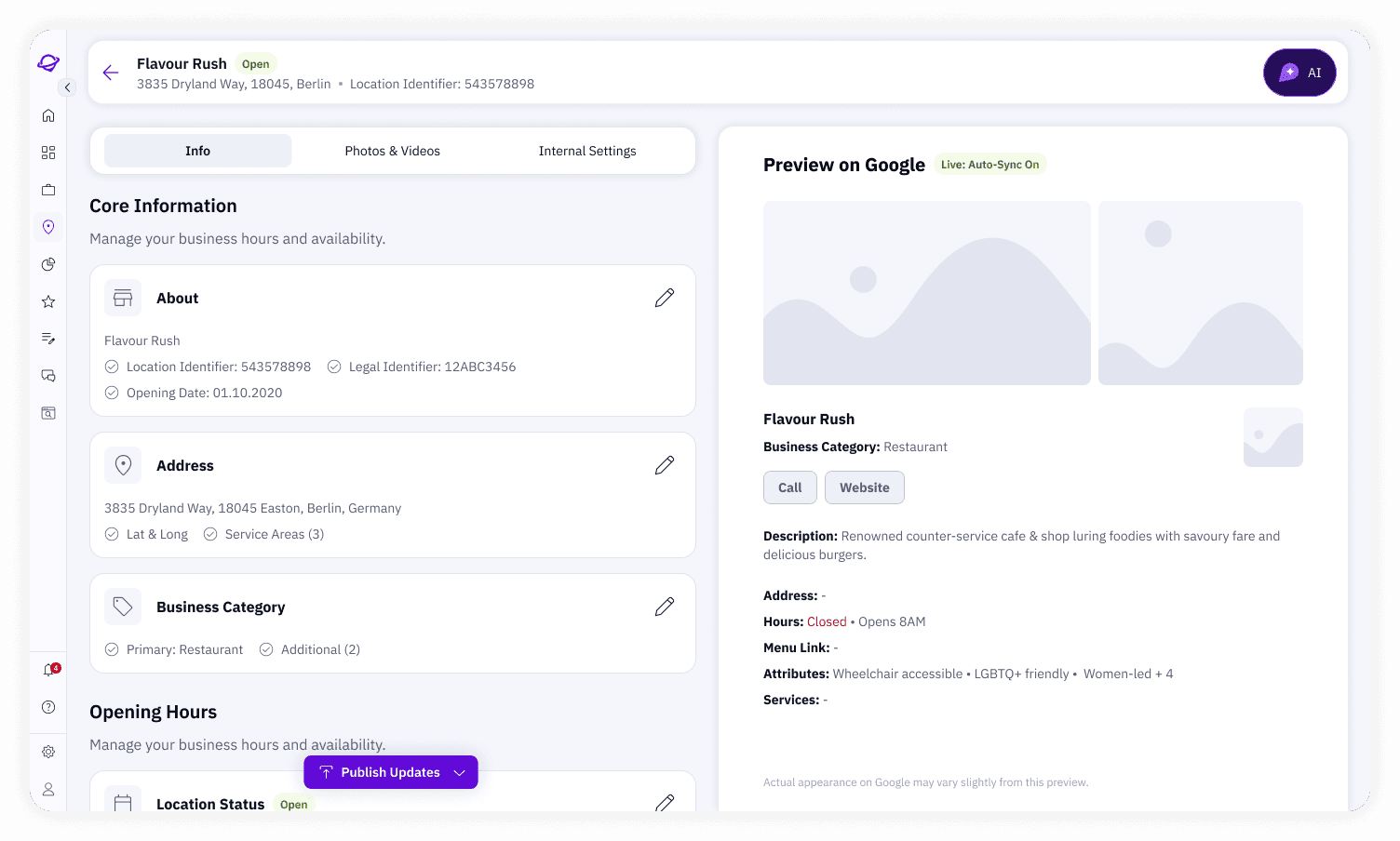
01 / Before & After
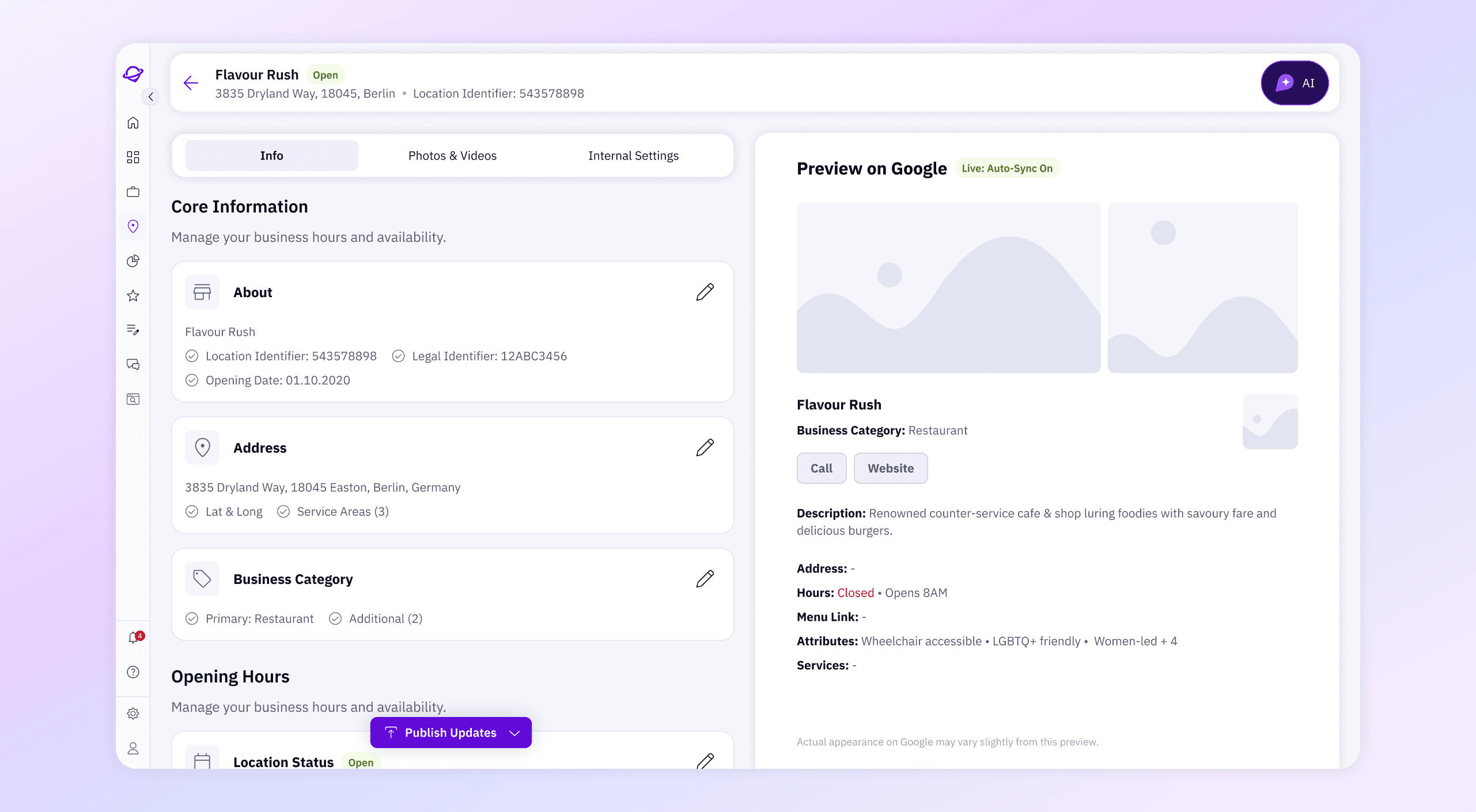
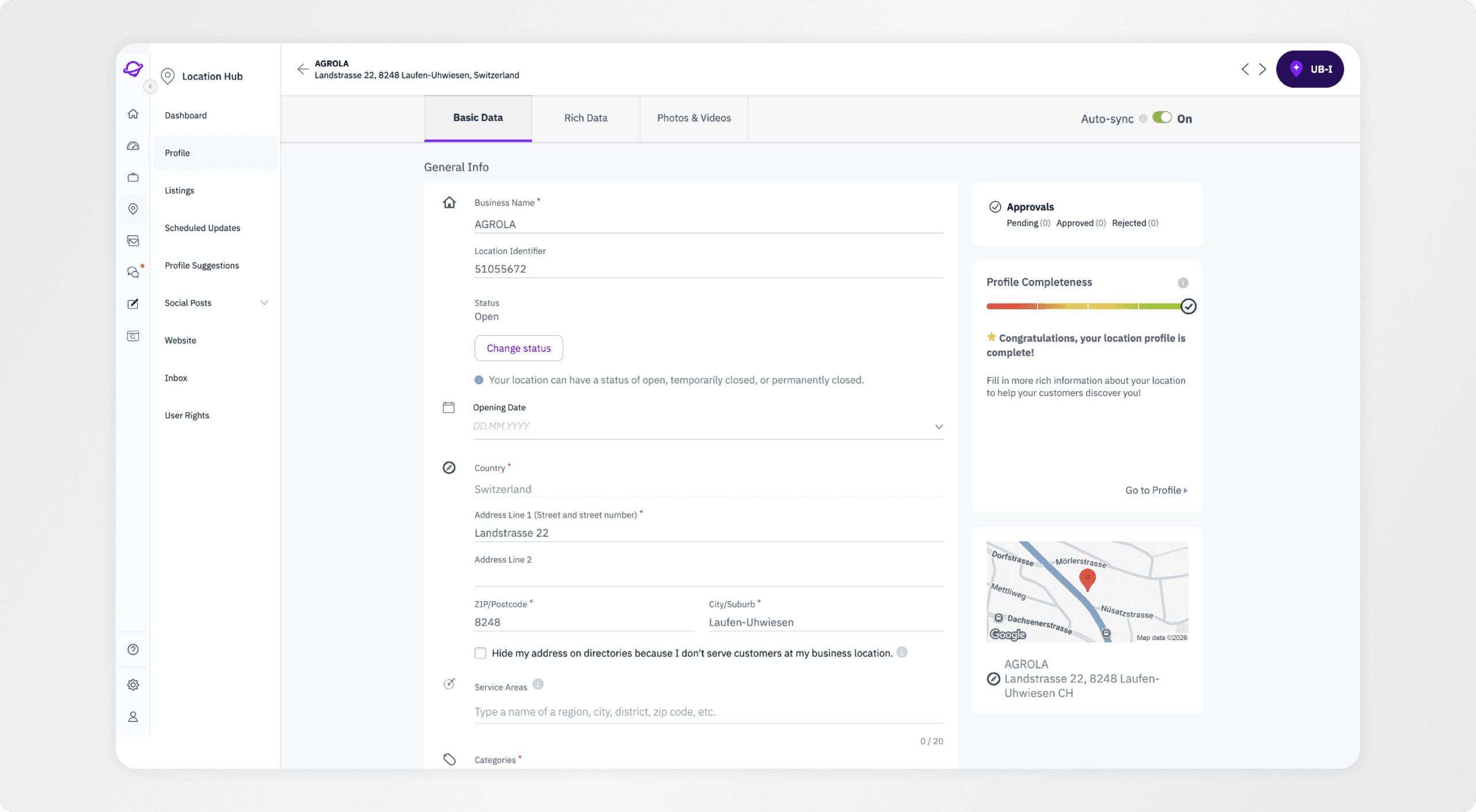
02 / Problem
A legacy Location Profile was slowing down teams managing hundreds of locations.
The Location Profile was over 10 years old and weighed down by technical and UX debt. Users navigated dozens of unclear fields with little guidance on meaning, priority, or publication, making profile management difficult at scale.
70 - 3k + locations
Managed per customer in the Location Profile
Cognitive Load
Dozens of fields with unclear priority or explanation
Behavioral Friction
Users leave Uberall to check Google Business Profile
Operational Cost
High support volume due to unclear fields and actions
03 / Strategy
Design principles used to simplify complexity without breaking scale.
Clarity over completeness
Focus on what matters first
Intent-based IA
Organized around user goals
Guided workflow
From static form → decisions
Progressive priority
Required vs optional fields
04 / What I Did
#1 Research
Understanding where users struggled at scale
Synthesized usability findings & support data to identify confusion around field meaning, priority, and publication.
5 usability tests
#2 Design & Testing
Restructuring the Location Profile around user intent
Redesigned IA, introduced clearer hierarchy, and validated the new structure through usability testing and iteration.
SUS 79.1
#3 Collaboration
Aligning design direction under technical constraints
Worked with Product, Engineering, and Customer Success to balance UX improvements with legacy system limitations.
#4 Delivery & QA
Shipping within tight timelines and setting up iteration
Delivered the redesign in one month, documented decisions, and flagged follow-up opportunities for future releases.
1-month delivery
Next Project
Sign Up Flow Redesign
© 2026 Jane Sadovskaya - Senior Product Designer
Multi-Location Onboarding Redesign
Reduced onboarding friction by 35% and boosted completion rates by 42%
Role
Lead Product Designer
Time Period
Q3 - Q4 2024
Company
Uberall
Platform
Web Application
01 / Problem
Enterprise clients managing hundreds of locations were abandoning the onboarding process at an alarming rate. The existing flow required users to input data location-by-location, leading to hours of tedious work and frustration
58%
Abandonment rate for multi-location onboarding
4.5h
Average time to complete setup for 100 locations
12+
Support tickets per client during onboarding
02 / Strategy
I focused on progressive disclosure and bulk operations—allowing users to start simple and scale complexity only when needed. The goal was to transform a tedious task into a streamlined workflow that respects the user's time and intelligence.
03 / What I Did
Research
8 user interviews
Support ticket analysis
Journey mapping
Design & Testing
CSV upload prototyping
Progressive onboarding
5 usability tests
Collaboration
Engineering alignment
Detailed spec creation
Customer success sync
Delivery & QA
Multi-device QA
Help documentation
Metrics monitoring
04 / Before & After
Before
After
05 / Impact
42%
Increase in onboarding completion rate
35%
IReduction in time to complete setup
89%
Decrease in support tickets in onboarding
Next Project
Accelerating GBP Access for Agencies
Multi-Location Onboarding Redesign
Reduced onboarding friction by 35% and boosted completion rates by 42%
Role
Lead Product Designer
Time Period
Q3 - Q4 2024
Company
Uberall
Platform
Web Application
01 / Problem
Enterprise clients managing hundreds of locations were abandoning the onboarding process at an alarming rate. The existing flow required users to input data location-by-location, leading to hours of tedious work and frustration
58%
Abandonment rate for multi-location onboarding
4.5h
Average time to complete setup for 100 locations
12+
Support tickets per client during onboarding
02 / Strategy
I focused on progressive disclosure and bulk operations—allowing users to start simple and scale complexity only when needed. The goal was to transform a tedious task into a streamlined workflow that respects the user's time and intelligence.
03 / What I Did
Research
8 user interviews
Support ticket analysis
Journey mapping
Design & Testing
CSV upload prototyping
Progressive onboarding
5 usability tests
Collaboration
Engineering alignment
Detailed spec creation
Customer success sync
Delivery & QA
Multi-device QA
Help documentation
Metrics monitoring
04 / Before & After
Before
After
05 / Impact
42%
Increase in onboarding completion rate
35%
IReduction in time to complete setup
89%
Decrease in support tickets in onboarding
Next Project